I Switched to the Alliwava Gh8 Mini Pc and Here is What Happened
The Alliwava Gh8 Mini Pc arrives at a moment when compact desktops have matured beyond mere convenience into viable daily drivers. For buyers who prize a small footprint without compromising on compute capability, the GH8 promises notebook-class silicon, modern connectivity, and desktop flexibility. This article walks through a real-world evaluation: setup, everyday performance, thermals and noise, connectivity, upgradeability, and how the GH8 stacks up against typical alternatives. It concludes with a clear buying guide for prospective purchasers and a practical, balanced verdict.
Introduction: Why someone would switch to a mini PC
Mini PCs are no longer niche gadgets. They are attractive to a wide range of users: remote workers consolidating desk clutter, media enthusiasts building quiet home theaters, creative professionals who need powerful CPUs in a small chassis, and small businesses seeking compact, low-power deployment options. The Alliwava Gh8 positions itself toward the higher end of this market by pairing a high-performance mobile Ryzen processor with modern ports such as USB4 and multiple display outputs. The question for anyone considering a switch is whether that compact chassis can reliably deliver sustained performance and flexible connectivity for day-to-day tasks.
First impressions and setup
Out of the box, the GH8 gives a premium, dense feel. The chassis is small enough to VESA-mount behind a monitor or tuck into a media cabinet, and yet it’s heavier than many ultraportable mini boxes because of more substantial cooling components. Setup is straightforward: users can install M.2 storage and DDR5 SODIMMs (if the SKU is unpopulated or they want to upgrade), connect displays across the supplied HDMI/DisplayPort/USB-C outputs, and plug in networking and peripherals.
Windows 11 Pro typically ships preinstalled on retail units, and basic drivers for Wi‑Fi, Bluetooth, and LAN come from the manufacturer. For users who prefer Linux or a custom image, the GH8’s hardware is largely friendly to common distributions, although any high-performance small-form-factor PC benefits from driver checks before deployment.
Detailed product review and analysis
Performance: CPU, GPU, RAM and storage
The GH8 commonly features a high-performance mobile Ryzen CPU. In everyday multitasking—document editing, dozens of browser tabs, Slack or Teams, and light media editing—the system is responsive. The integrated AMD graphics are capable for video playback, GPU‑assisted tasks (like accelerated video transcodes), and light to moderate gaming at sensible settings.
Where the GH8 stands out is memory and storage speed: modern DDR5 RAM and a PCIe NVMe SSD provide snappy app launches and fast file operations. For creators, the option to expand RAM and add a second M.2 drive is a practical advantage—enabling larger scratch disks or separate OS and project drives without resorting to external enclosures.
Thermals and sustained workloads
Small enclosures are always a balancing act between cooling and acoustics. The GH8 uses an active cooling solution tuned across modes (quiet, balanced, performance). Under light loads it is unobtrusive, producing noise levels similar to a quiet laptop. In sustained heavy workloads—compiling code, rendering a video timeline, or intensive multi-core benchmarks—temperatures rise and the fans become more audible, but the system maintains steady clocks within the design power envelope. For most users, this means consistent real-world performance without thermal throttling that cripples throughput; power users should expect audible fans during extended high‑TDP activity.
Connectivity: ports, displays, and networking
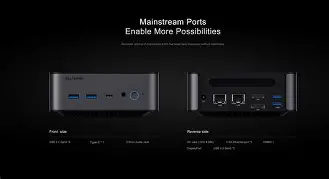
Buyers often choose a mini PC for connectivity. The GH8 covers the essentials and then some: a mix of Type-A and Type-C ports, at least one USB4-capable port for high bandwidth devices or external displays, full-size HDMI and DisplayPort outputs, and dual 2.5GbE Ethernet ports on many configurations. The multi-display support is a compelling selling point for productivity and media setups—users can drive multiple 4K panels from a single device.
Shop the latest Laptops & Computers picks on Amazon.
View Offers →Wireless connectivity with Wi‑Fi 6E and Bluetooth 5.x means low-latency wireless for both home and office. The presence of dual 2.5GbE ports also appeals to network-heavy use cases such as NAS front-ends, small virtualization hosts, or multi-device edge deployments.
Software, BIOS, and user controls
Alliwava’s firmware typically offers selectable power/performance profiles, allowing owners to prioritize silent operation or maximum throughput. For IT admins or advanced enthusiasts, options like Wake-on-LAN and BIOS-level power scheduling are useful. Windows drivers are generally mature; Linux users may need to consult community notes for optimal thermal and power profile adjustments.
Upgradeability and maintenance
The GH8 is more upgrade-friendly than many sealed mini PCs: memory modules and M.2 drives are accessible, and some varia…Real-world use cases
- Home office and remote work: A compact desktop with multiple monitor outputs and strong single-core performance makes the GH8 ideal for productivity suites, video calls, and multitasking without a large workstation chassis.
- Media center / HTPC: Quiet modes, hardware-accelerated 4K playback, and the HDMI/DisplayPort outputs allow the unit to serve as a stylish and compact living-room PC.
- Content creation: Photo editing, light video editing, and audio production benefit from fast storage and additional RAM; creators who render frequently may want to opt for the higher TDP configuration.
- Light gaming: Integrated Radeon graphics handle esports titles and older AAA games at lowered settings; pairing with external GPUs is limited and generally not the primary use case.
- Small business / edge server: Dual 2.5GbE networking and low-power operation fit small server roles, digital signage, or point-of-sale deployments where space and noise are constraints.
Pros & Cons
- Pros:
- Compact footprint with VESA-mounting options; saves desk space.
- Notebook-class Ryzen performance in a desktop form factor.
- Modern connectivity including USB4, multiple display outputs, and often dual 2.5GbE.
- DDR5 memory and PCIe NVMe storage provide fast real-world responsiveness.
- Accessible upgrade paths for RAM and storage extend usable life.
- Cons:
- Active cooling leads to noticeable fan noise under sustained heavy loads.
- High TDP workloads will push thermals, so desktop towers still outperform for extreme tasks.
- Some variant SKUs and region availability can make specific configurations hard to find.
- Limited or no internal expansion beyond M.2 and SODIMM slots—no full‑size PCIe expansion.
How the Alliwava Gh8 compares to other compact desktops
| Model | Target user | Notable strengths | Expandability | Connectivity highlights |
|---|---|---|---|---|
| Alliwava Gh8 | Prosumer, creator, heavy-duty home office | High-performance mobile Ryzen in a tiny chassis; strong I/O for displays and networking | Dual M.2 slots and SODIMM RAM; user-upgradable memory and storage | USB4, DisplayPort, HDMI, Wi‑Fi 6E, dual 2.5GbE (typical) |
| High-end Intel NUC (typical) | Enterprise/enthusiast users wanting compact Intel platforms | Wide SKU variety, often strong single-threaded performance and Thunderbolt support | SODIMM + M.2 options vary by model; some have more robust Thunderbolt docks | Thunderbolt 4 on many models, multiple USBs, 2.5GbE or 10GbE on some SKUs |
| Apple Mac mini (Apple silicon) | Mac users, creative pros in Apple ecosystem | Exceptional efficiency and macOS-optimized performance; quiet operation | Limited internal upgrades (memory typically fixed); external storage via Thunderbolt | Thunderbolt / USB4, HDMI, Wi‑Fi 6, reliable macOS ecosystem |
Note: the table highlights general differences in approach rather than appliance-level numeric specs. The GH8’s niche is raw mobile Ryzen muscle combined with versatile, modern I/O—an attractive middle ground between highly integrated consumer devices and bare-bones enterprise boxes.
Buying guide: what to look for and recommended configurations
When evaluating a GH8 (or any compact mini PC), buyers should prioritize the following criteria based on their intended use.
1. Define the workload
- Home office or daily driver: prioritize single-core speed and at least 16GB of RAM. A 512GB NVMe SSD is typically sufficient, with room to expand.
- Content creator (photo/video/audio): choose 32GB or more RAM, a larger NVMe SSD (1TB+), and a higher sustained-power/thermal profile if available.
- Media center / HTPC: prioritize quiet operation, HDMI/DisplayPort outputs, and reliable hardware-accelerated codecs.
- Edge server or virtualization: ensure adequate RAM expansion and dual-network interfaces; consider storage redundancy via external NAS if needed.
2. Pay attention to thermal/power modes
Look for models or BIOS features that let the user tune power vs. noise. If the environment requires whisper‑quiet operation (bedroom, living room), pick a configuration and power profile designed for low acoustic output. If peak sustained performance is the priority, accept that fans will be audible during heavy loads.
3. Connectivity and displays
Verify the number of displays and the resolution/refresh rates required. If a user plans to drive multiple 4K monitors, confirm the GPU and the advertised multi‑display support. For peripheral-heavy setups, ensure enough USB ports and at least one high-bandwidth port (USB4/Thunderbolt or equivalent) for docks or fast external storage.
Find top-rated Laptops & Computers products at great prices.
Browse Now →4. Upgrade path and serviceability
Confirm whether RAM is user-replaceable and whether a second M.2 slot is present. These two factors have the most impact on extending the lifespan of a compact PC.
5. Networking needs
For network prosumers, dual 2.5GbE is a strong advantage; for wireless-first users, ensure the unit has Wi‑Fi 6/6E and the correct Bluetooth version for peripherals.
6. Operating system and drivers
Check driver support for your preferred OS. Windows users will find broad compatibility, while Linux users should research community notes for any quirks specific to the mini PC’s Wi‑Fi, power-management, or firmware.
Recommended starting configurations
- Remote worker / student: 16–32GB RAM, 512GB NVMe, quiet power profile.
- Creator / power user: 32–64GB RAM, 1TB+ NVMe, balanced or performance power profile.
- Media hub / light HTPC: 16GB RAM, 512GB NVMe or smaller for streaming, prioritize HDMI and quiet mode.
- Small edge server: 32GB+ RAM, dual M.2 configured for capacity, prioritize wired networking.
Practical tips and final considerations
- Thermal placement: Don’t tuck the GH8 into a completely closed cabinet without airflow. Compact units need space for intake and exhaust to avoid heat buildup.
- Peripherals: If many peripherals are planned, consider a powered USB hub or a dock to reduce strain on the system’s internal power delivery.
- Backups and redundancy: For creators and business users, a single NVMe is convenient but not a replacement for regular backups or a redundant storage strategy.
- Warranty and regional support: Check warranty terms and regional support options; some small-form-factor vendors have regionally different service channels and firmware releases.
Conclusion
The Alliwava Gh8 Mini Pc represents a convincing, modern take on the compact desktop: it brings high-performance mobile Ryzen silicon into a small, upgradeable chassis with contemporary I/O. For buyers who want a powerful, space-saving machine for productivity, content creation, or networked tasks, the GH8 delivers a strong value proposition. Its primary trade-offs are the expected acoustic signature during sustained heavy workloads and the limits inherent in small-form-factor expandability. For many users, those trade-offs are acceptable in exchange for the GH8’s speed, connectivity, and compact convenience.
Ultimately, switching to the GH8 makes the most sense for people who need more performance than basic mini-PCs offer but who don’t want to commit to a full tower. With sensible configuration choices—matching RAM, storage, and power mode to the intended workload—the Alliwava Gh8 can serve as a long-lived, flexible desktop that fits into tight spaces and demanding workflows alike.