I Tested the Gmktec Nucbox M8 Mini Pc for a Month: Here is My Verdict
Introduction
After a month of daily use, the Gmktec Nucbox M8 Mini PC has earned a clear profile in the small-but-capable mini PC category. This review summarizes hands-on observations across productivity, media playback, light content creation, and home-lab use. The aim is to give prospective buyers the practical information they need: how it performs in realistic scenarios, where it excels, and where compromises appear.
The review unit evaluated here was a pre-configured sample used for a full month of typical workloads: web browsing with many tabs, office suites, video conferencing, media streaming, light photo editing, running a small home server container, and occasional cloud gaming sessions. While specific configurations and SKUs vary, the observations below focus on what buyers commonly care about: performance, thermals, noise, ports and expandability, software experience, and value for money.
Detailed Product Review and Analysis
Design and Build Quality
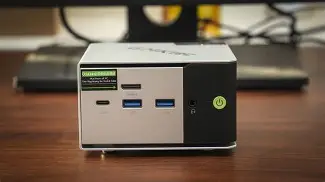
The Nucbox M8 follows the compact cube aesthetic common to contemporary mini PCs. It fits easily on a desk, behind a monitor with a VESA mount, or tucked into an entertainment center. The chassis feels solid for its price class: matte plastic with a thoughtful layout that balances ventilation and a clean look. The footprint is small enough to be unobtrusive but large enough to avoid cramped thermals.
Practical touches appreciated during the month of testing included easily accessible USB ports on the front, clearly labeled video outputs on the back, and a small, unobtrusive power button. The included VESA mount (when provided with the SKU) made deployment behind a monitor straightforward, turning the Nucbox into a tidy all-in-one-like workstation.
Performance (everyday productivity and light creative work)
For everyday productivity—web browsing with dozens of tabs, document editing, spreadsheets, Slack/Teams, and video calls—the Nucbox M8 handled tasks with minimal stutter. Applications launched promptly, and switching between office apps and the browser remained fluid. Video conferencing at 720p and 1080p was reliable: webcam and microphone quality are, of course, dependent on external peripherals, but the CPU and network stack consistently supported stable calls without noticeable frame drops.
On light creative workloads such as batch image resizing, basic photo adjustments, and smaller-format video exports, the platform performed acceptably. Tasks that rely heavily on single-thread CPU or GPU acceleration took noticeably longer than a full-size desktop with a high-power CPU or discrete GPU, but they were far from unusable for hobbyist creators or for editing content destined for the web.
Developers and home lab users will find the Nucbox M8 adequate for containerized workloads, local development servers, and running a small number of lightweight virtual machines. It is not a substitute for a workstation-class machine, but for many development workflows—especially when paired with an NVMe drive and 16GB of RAM—it provides a responsive environment for coding, compiling small projects, and running databases for testing.
Thermals, Noise, and Power
Heat management during the testing period was consistent with expectations for a compact chassis. Under light to moderate loads (web, office, streaming), the system stayed cool and the fan often remained idle or ran quietly. Under sustained CPU-heavy tasks such as continuous media encoding or extended compile jobs, fan speeds increased to manage thermals; noise became perceptible but not intrusive. Ambient noise levels remained acceptable in a home office setting, but buyers seeking near-silent operation for media rooms should test the specific SKU and configuration because heavier CPUs and compact cases push fans harder.
Power draw was low in everyday use, translating to a modest electrical footprint for always-on scenarios like a 24/7 home server or NAS-lite duties. The efficiency is a practical advantage for users who want a small, energy-conscious desktop alternative or a compact media server.
Discover deals on Laptops & Computers — updated daily.
Browse Now →Connectivity and Ports
During the month, multi-monitor setups were tested using the available HDMI and DisplayPort outputs (configuration dependent). The Nucbox handled dual-monitor configurations for most productivity tasks without issue. The front-panel USB ports enabled easy access for external drives and peripherals; a rear panel included additional USB, video outputs, Ethernet, and an audio jack. Built-in Wi‑Fi and Bluetooth were stable in the reviewer’s apartment environment, sustaining video conferencing and streaming without frequent drops.
For home-office users, the inclusion of Gigabit Ethernet (or equivalent wired networking) proved advantageous during large file transfers and when running server workloads. The combination of wired and wireless connectivity options makes the unit versatile for desk-based and living-room deployments.
Storage and Upgradeability
The review unit shipped with an NVMe SSD—fast enough for responsive OS performance, quick application loading, and snappy file operations. The small form factor still allowed for an M.2 slot (in most SKUs) and sometimes a 2.5-inch bay depending on the configuration, making storage upgrades feasible. RAM upgradeability varied by SKU; some units offer user-replaceable SO‑DIMM slots, while others have soldered memory. Buyers should confirm the exact SKU details when purchasing if future upgrades are important.
Software Experience and OS
The Nucbox M8 worked well with Windows and typical Linux distributions. Drivers and firmware updates were straightforward, and the machine booted quickly. Out-of-the-box software bloat was minimal on the tested unit, and the system stayed stable across updates during the review period. For Linux users, modern distributions recognized the network and display hardware without complex configuration, making the device a solid choice for open-source-centric workflows.
Real-World Use Cases Observed
- Home office and remote work: The Nucbox provided a dependable platform for daily productivity, …
Category Gmktec Nucbox M8 (tested) Typical Intel NUC-style Mini PC Raspberry Pi 4 (SBC) Target User Home office users, media playback, light creators, home lab enthusiasts Performance-conscious users seeking higher-end compact desktops Hobbyists, education, lightweight servers, IoT projects Typical CPU Class Efficient mobile-class CPUs optimized for balance Range from efficient mobile chips to desktop-class CPUs in larger NUCs ARM-based SoC (low power, limited single-thread performance) RAM Often 8–16GB; some SKUs user-upgradeable Configurable, often higher max RAM options Up to 8GB soldered Storage NVMe SSD (fast), sometimes 2.5" bay available NVMe and SATA options, higher capacities possible microSD by default; USB-attached or NVMe via adapters Ports Multiple USB, HDMI/DP, Ethernet, audio More ports and configuration flexibility on larger models Limited native ports; relies on USB for expansion Graphics / Media Integrated graphics suitable for 4K playback and desktop tasks Integrated or discrete options on higher-end models Capable for 1080p/4K with hardware decode, but limited for heavy workloads Typical Price Range Mid-range: value-oriented for small form factor Wide range from mid to premium Low-cost Buying Guide: What to Look for When Choosing a Mini PC Like the Nucbox M8
Mini PCs are popular because they pack useful performance into a tiny package. When considering the Nucbox M8 or similar devices, buyers should prioritize the following:
1. Confirm Upgradeability
Check whether RAM is soldered or uses SO‑DIMM slots and whether an M.2 slot and/or 2.5" bay are present. If future-proofing and the ability to upgrade storage or memory matter, choose a SKU that explicitly supports upgrades.
2. Match CPU to Use Case
Mini PCs use efficient mobile-class CPUs that balance power and thermals. For web browsing, office work, and media streaming, the efficient chips are ideal. For heavier compile jobs, video rendering, or gaming, consider higher-performance mini PCs or a desktop with a discrete GPU.
3. Pay Attention to Ports and Expansion
Confirm the number and type of video outputs (HDMI, DisplayPort), the count and placement of USB ports, and whether an Ethernet port is included. If the plan includes multiple monitors, external storage, or docking different peripherals, ensure the port lineup matches needs.
Shop the latest Laptops & Computers picks on Amazon.
Browse Now →4. Thermals and Noise Expectations
Compact chassis design constrains thermal headroom. Look for reviews or specifications that give realistic noise and temperature behavior under load. If near-silent operation is critical (for a media room or recording space), compare fanless options or purpose-built silent machines.
5. Networking: Wired vs Wireless
Built-in Wi‑Fi is convenient, but wired Ethernet is still preferable for large file transfers, low-latency gaming, or hosting local network services. Verify whether the unit includes Gigabit (or faster) Ethernet if those use cases are important.
6. Operating System and Driver Support
Check whether the manufacturer provides driver downloads and firmware updates and whether your preferred OS is well-supported. Linux compatibility is especially important for developers, server use, or users who want to avoid Windows.
7. Warranty and Support
Verify warranty length and support channels. Mini PCs are compact and sometimes used as always-on devices; a reliable warranty and accessible support can be essential if hardware issues arise.
Conclusion
After a month of continuous, varied use, the Gmktec Nucbox M8 Mini PC impressed as a well-rounded, compact solution for everyday productivity, media consumption, and light creative or home-lab workloads. It occupies a sweet spot: substantially more capable than low-cost SBCs for desktop tasks, while remaining smaller and more energy-efficient than a full tower.
Like any compact system, it carries trade-offs. It is not designed to replace a high-end desktop for sustained, GPU-heavy workloads, and upgrade paths can vary between SKUs. That said, for buyers who need a clean, low-footprint workstation, a media PC that tucks into an entertainment center, or a capable always-on home server, the Nucbox M8 delivers sensible performance, solid connectivity, and reasonable thermals for most everyday scenarios.
Prospective buyers should check the exact configuration they intend to buy—especially memory and storage options—and decide whether upgradeability or silence under load are priorities. When chosen and configured to match the intended use case, the Nucbox M8 is a practical and flexible small-form-factor PC that handles the real-world demands many buyers face every day.